
Top 7 NoSQL Databases in 2026
The best NoSQL databases in 2026, ranked: MongoDB, Redis, Amazon DynamoDB, Apache Cassandra, Couchbase, ScyllaDB and Aerospike. Data models, current licenses, and real pricing for each.


TL;DR
- The leading NoSQL databases in 2026 are MongoDB, Redis, Amazon DynamoDB, Apache Cassandra, Couchbase, ScyllaDB, and Aerospike — covering document, key-value, and wide-column models.
- MongoDB (server 8.0) is the default for general-purpose document workloads; its Atlas cloud has a free tier and dedicated clusters from about $57/month.
- Licensing shifted hard in 2024–2025: Redis added AGPLv3 back in Redis 8 (open source again), while ScyllaDB moved to source-available only and dropped its open-source edition.
- Ownership moved too: IBM acquired DataStax (Cassandra's commercial vendor) and Couchbase went private under Haveli Investments, both in 2025.
A NoSQL database stores data in flexible, non-relational models — documents, key-value pairs, or wide columns — instead of fixed tables, trading SQL's rigid schema for horizontal scale and speed. The top NoSQL databases in 2026 are MongoDB, Redis, Amazon DynamoDB, Apache Cassandra, Couchbase, ScyllaDB, and Aerospike. MongoDB leads for document workloads, Redis for in-memory caching, DynamoDB for serverless scale on AWS, and Cassandra for write-heavy distributed systems. This guide ranks all seven on maturity, adoption, and capability, with current licensing and real pricing.
How we picked these
We ranked on what matters when you commit a production system to a database:
- Maturity and adoption: proven at scale, with a real ecosystem of drivers, tools, and hiring pool.
- Capability: the strength and fit of the data model for the jobs the database is built for.
- Deployment and license: whether you can self-host, and under what license — which changed for several vendors in 2025.
- Operational cost and complexity: pricing transparency and how hard it is to run.
We make no claim about independence or paid placement. No vendor paid to appear here. Licensing and ownership facts are current as of October 2026.
Quick comparison
| Database | Best for | Data model | Deployment & license |
|---|---|---|---|
| MongoDB | General-purpose document apps | Document (multi-model) | Self-host (SSPL) + Atlas managed |
| Redis | Caching, sessions, real-time | Key-value / in-memory | Self-host (AGPLv3) + Redis Cloud |
| Amazon DynamoDB | Serverless scale on AWS | Key-value / document | Managed only (proprietary, AWS) |
| Apache Cassandra | Write-heavy, multi-region | Wide-column | Self-host (Apache 2.0) + DataStax |
| Couchbase | SQL-over-JSON + mobile sync | Document (multi-model) | Self-host + Capella managed |
| ScyllaDB | High throughput per node | Wide-column | Self-host (source-available) + Cloud |
| Aerospike | Real-time at large data volumes | Key-value | Self-host (AGPLv3) + Enterprise |
1. MongoDB
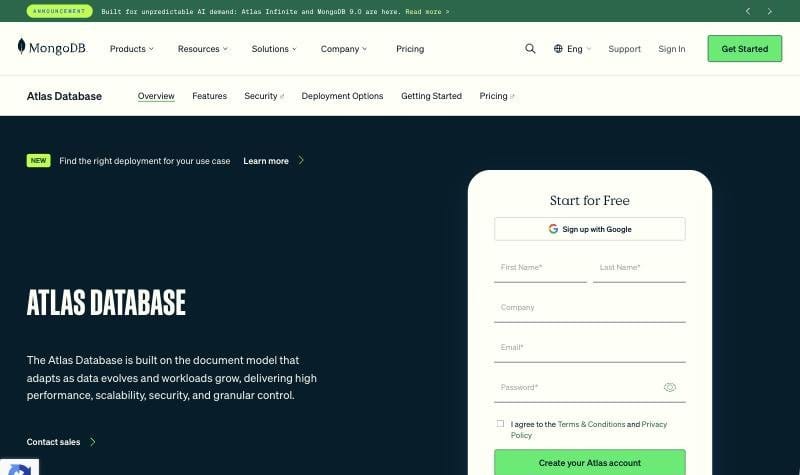
MongoDB is the most widely adopted NoSQL database and the default choice for general-purpose document workloads. It stores data as flexible BSON documents, scales horizontally through sharding, and has grown into a multi-model platform with built-in full-text search, vector search, and time-series collections — which means many teams no longer bolt on a separate search or vector database. The current server release is MongoDB 8.0, generally available since October 2024. The company (NASDAQ: MDB) sells a managed cloud, Atlas, alongside the self-hosted Community and Enterprise editions.
Best for: general-purpose applications needing flexible JSON-like documents and a managed cloud.
Pros - Largest document-database ecosystem: drivers, tooling, learning resources, and hiring pool. - Atlas offers a free tier (M0, 512 MB) plus a true serverless option, with dedicated clusters (M10) from about $0.08/hour (~$57/month) as of October 2026 (pricing). - Integrated vector and full-text search reduce the need for separate systems.
Cons - The Server Side Public License (SSPL) on the Community edition is not OSI-approved and blocks third parties from offering it as a managed service. - Atlas costs climb quickly as you scale up cluster tiers. - Running large self-hosted sharded clusters is still operationally demanding.
2. Redis

Redis is the near-universal in-memory key-value store, used for caching, session storage, rate limiting, leaderboards, and queues, with support for lists, sets, streams, JSON, and vector search. Holding data in RAM gives it sub-millisecond operations. Its licensing has been turbulent: Redis moved from the permissive BSD license to source-available SSPL/RSALv2 in 2024, then added AGPLv3 back in Redis 8 (May 2025), making Redis open source again under a tri-license. The current release line is Redis 8.2 (2026). The 2024 change spawned Valkey, a BSD-licensed fork now bundled by several cloud providers.
Best for: caching, sessions, real-time counters, and queues.
Pros - Fastest widely deployed key-value store, with sub-millisecond latency and a vast client library ecosystem. - Open source again under AGPLv3 as of Redis 8, alongside commercial options. - Redis Cloud offers a free 30 MB tier and Essentials plans from about $5/month (pricing, October 2026).
Cons - In-memory design makes large datasets expensive, because capacity is bounded by RAM. - Durability is weaker than disk-first databases unless carefully configured. - The 2024 license whiplash damaged community trust and created a competing fork now shipped by major clouds.
3. Amazon DynamoDB
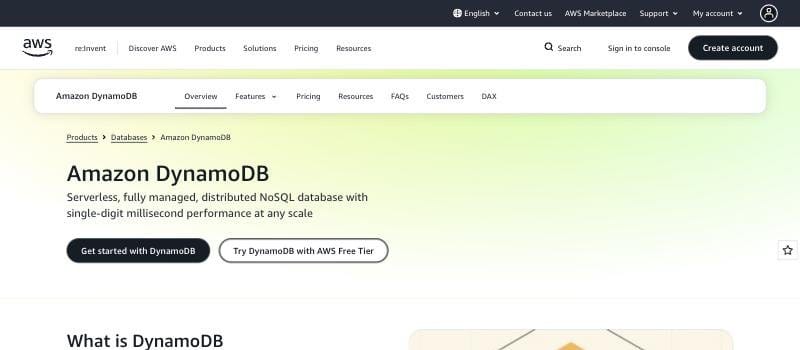
Amazon DynamoDB is AWS's fully managed, serverless key-value and document database, built for teams that want zero operational overhead and predictable performance at any scale. AWS advertises single-digit-millisecond latency regardless of table size, automatic scaling, and multi-region global tables. There is no self-hosted version — DynamoDB runs only on AWS — which makes it the least portable option here but one of the simplest to operate.
Best for: AWS-native teams wanting hands-off scaling for spiky or massive workloads.
Pros - True serverless auto-scaling with no servers, clusters, or capacity planning to manage. - Consistent single-digit-millisecond latency at scale, per AWS, with multi-region global tables. - Deep AWS integration (Lambda, DynamoDB Streams, IAM) for event-driven architectures.
Cons - Hard vendor lock-in: there is no path to run DynamoDB off AWS. - On-demand pricing ($0.125 per million reads, $0.625 per million writes, $0.25/GB-month storage in us-east-1, October 2026) is hard to forecast under bursty traffic or hot partitions. - A limited query model with awkward secondary indexing and no joins or ad-hoc queries.
4. Apache Cassandra
Apache Cassandra is the mature wide-column store for write-heavy, always-on, globally distributed workloads. Its masterless architecture has no single point of failure, scales writes linearly across nodes, and offers tunable consistency across data centers. The current release, Cassandra 5.0 (September 2024), added native vector search and storage-attached indexing. The core project is licensed under Apache License 2.0 — the strongest open-source position on this list. Commercial support and the managed Astra DB service come from DataStax, which IBM acquired in 2025, folding it into the watsonx portfolio; the Apache project itself remains independent.
Best for: always-on, write-heavy, multi-region systems that need no license risk.
Pros - Genuinely open source under Apache 2.0, fully self-hostable with no vendor dependency. - Proven linear write scalability and multi-region high availability with no single point of failure. - Cassandra 5.0 adds native vector search, modernizing it for AI workloads.
Cons - Operationally complex to self-manage: tuning, repairs, and compaction demand expertise. - Eventual-consistency defaults and a query-first data model mean no ad-hoc joins or flexible queries. - The main commercial path is now concentrated under IBM following the DataStax acquisition.
5. Couchbase
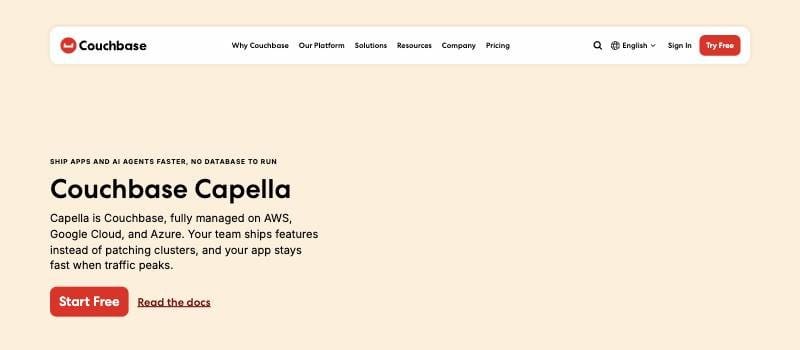
Couchbase is a distributed document database that pairs JSON storage with SQL++ (N1QL), a SQL-like query language over documents, plus a built-in caching layer, full-text search, eventing, and mobile/edge sync through Couchbase Lite. That combination — SQL-on-JSON with integrated caching and offline sync — is its main differentiator. It offers a self-managed Server (Community under Apache 2.0, plus commercial Enterprise) and the managed Capella service. In a major change, Couchbase was taken private by Haveli Investments in 2025 and delisted from Nasdaq, so its roadmap now sits with a private-equity owner.
Best for: enterprises wanting SQL-style querying over JSON plus mobile and edge sync.
Pros - SQL++ gives developers familiar SQL syntax over flexible JSON documents. - Integrated caching and Couchbase Lite mobile/edge sync are unusual in a single platform. - Capella has a free tier and clear per-node hourly pricing (from about $0.15/node/hour, October 2026, pricing).
Cons - Smaller community and ecosystem than MongoDB. - Now private-equity owned, which adds uncertainty to pricing and roadmap direction. - A heavier resource footprint, and advanced features are gated to Enterprise and Capella.
6. ScyllaDB
ScyllaDB is a wide-column store that reimplements Cassandra's model in C++ with a shard-per-core architecture (no JVM, no garbage collection), aiming for much higher throughput per node. It is compatible with both Cassandra's CQL and, through its Alternator interface, the DynamoDB API — easing migration from either. In 2025, ScyllaDB made a significant change: release 2025.1 became source-available, replacing both the old AGPL "open source" edition and the separate closed "enterprise" edition with a single unified product under ScyllaDB's own source-available license. Earlier AGPL versions remain available.
Best for: Cassandra or DynamoDB workloads that need more throughput per node.
Pros - Shard-per-core C++ design delivers high throughput on fewer nodes; ScyllaDB cites large cost-per-operation wins versus Cassandra (vendor benchmarks). - Drop-in compatibility with Cassandra CQL and the DynamoDB API simplifies migration. - A single unified edition now includes all features, rather than gating them to an enterprise tier.
Cons - No longer true open source — the 2025.1 shift to source-available removed the OSS guarantee that once distinguished it from Cassandra. - Smaller community and ecosystem than Cassandra. - Managed ScyllaDB Cloud pricing is consumption-based and not published as flat public rates.
7. Aerospike
Aerospike is a distributed key-value database built for ultra-low-latency, high-throughput real-time workloads at large data volumes — adtech bidding, fraud detection, fintech, and recommendation engines. Its Hybrid Memory Architecture keeps indexes in RAM while storing data on flash/SSD, delivering close to in-memory speed at the cost and density of disk. The Community edition is licensed under AGPLv3 but capped (up to 8 nodes / 2.5 TB), with Enterprise and a managed Aerospike Cloud above that.
Best for: real-time workloads needing high throughput and low latency at terabyte-to-petabyte scale.
Pros - Hybrid Memory Architecture delivers DRAM-class latency at flash economics, strong for large-scale real-time systems. - Community edition is self-hostable free under AGPLv3. - Strong consistency support and cross-datacenter replication.
Cons - Smaller community and talent pool than MongoDB, Cassandra, or Redis. - Enterprise and Cloud pricing is contact-sales only, with no published rates. - The Community edition's 8-node / 2.5 TB cap pushes serious deployments to paid tiers, and the key-value focus is narrower than general-purpose document stores.
How to choose
Pick by workload, not by brand.
- A general-purpose app with flexible data: MongoDB. The ecosystem, Atlas free tier, and built-in search make it the safe default.
- Caching, sessions, or real-time counters: Redis — now open source again under AGPLv3, or Valkey if you want a permissive BSD fork.
- You're all-in on AWS and want zero ops: DynamoDB, accepting the lock-in.
- Write-heavy, multi-region, and license-sensitive: Apache Cassandra under Apache 2.0.
- SQL-style queries over JSON plus mobile/edge sync: Couchbase.
- You run Cassandra or DynamoDB and need more per-node throughput: ScyllaDB, if source-available licensing is acceptable.
- Sub-millisecond real-time at huge scale: Aerospike.
The pattern to watch in 2026 is licensing and ownership. Cassandra and Redis are your strongest open-source bets; MongoDB's SSPL, ScyllaDB's source-available shift, and DynamoDB's proprietary lock-in each carry a trade-off; and Couchbase and DataStax both changed hands in 2025. Choose the database for the job, but read the license before you commit.
Frequently Asked Questions
What is a NoSQL database?
A NoSQL database stores data in non-relational models — documents, key-value pairs, wide columns, or graphs — rather than the fixed tables of a relational SQL database. This trades strict schemas and joins for horizontal scalability, flexible data structures, and high throughput, making NoSQL a fit for large-scale, fast-changing, or semi-structured workloads.
When should you use NoSQL versus a relational database?
Use NoSQL when you need horizontal scale, flexible or evolving schemas, very high write throughput, or semi-structured data like JSON documents. Use a relational database when you need complex joins, multi-row transactions, and strong consistency guarantees. Many systems use both, matching each store to the workload it handles best.
Are NoSQL databases ACID compliant?
Some are. DynamoDB, MongoDB, Couchbase, and Aerospike support transactions with varying ACID guarantees, though often scoped to a single document, partition, or region. Wide-column stores like Cassandra and ScyllaDB favor availability and tunable consistency over strict ACID transactions, reflecting their design for distributed, high-availability workloads.
What are the main types of NoSQL databases?
The four main types are document stores (MongoDB, Couchbase), key-value stores (Redis, DynamoDB, Aerospike), wide-column stores (Cassandra, ScyllaDB), and graph databases (a separate category). Many modern NoSQL databases are multi-model, supporting several of these — plus search and vector indexing — within one platform.
Which NoSQL database is the most popular?
MongoDB is the most widely adopted NoSQL database in 2026, with the largest ecosystem and developer base, followed by Redis for in-memory and caching use. Amazon DynamoDB leads among fully managed cloud-native options for teams already on AWS.
Editor's note — sources: MongoDB (mongodb.com, pricing); Redis (redis.io, pricing); Amazon DynamoDB (aws.amazon.com/dynamodb); Apache Cassandra (cassandra.apache.org); Couchbase (couchbase.com); ScyllaDB (scylladb.com); Aerospike (aerospike.com). Versions, licenses, ownership changes, and pricing verified as of October 2026; license terms and managed-service pricing change — confirm on each vendor's site before committing.