
Big Tech's AI Slowdown Pact
How three rivals agreed to slow the pace of frontier AI development - and ran straight into antitrust law, a president who calls the risk a hoax, and a chip industry with no interest in braking.

How three rivals agreed to slow the pace of frontier AI development — and ran straight into antitrust law, a president who calls the risk a hoax, and a chip industry with no interest in braking.
The labs that compete for every researcher and every enterprise contract are now trying to coordinate on speed, and there is no legal mechanism that lets them do it.
Jensen Huang was onstage in Los Angeles on Monday morning when his phone rang with a call he couldn't send to voicemail. He asked a stagehand for a second microphone, held the phone up, and let a room full of venture capitalists listen to the President of the United States dismiss the argument that had consumed the industry all weekend. "It's a hoax," Trump said, according to TechCrunch's account of the call. Huang agreed. The crowd applauded.
Twenty-four hours later, OpenAI's global policy chief stood in Washington and confirmed the thing the applause was aimed at. Chris Lehane told reporters on Tuesday that OpenAI has been working with Anthropic and Google DeepMind on AI safety for weeks — not days, not since the weekend, but for weeks before any of it became public. The three companies that between them define the frontier have been quietly negotiating how fast that frontier should move.
That is the story. Not the essay, not the phone call. The fact that competitors in the most capital-intensive race in technology have been talking to each other about restraint, and that nobody involved has a clean answer for whether they are allowed to.
What actually happened this week
The sequence matters, because it explains why the industry looks so uncoordinated while coordinating.
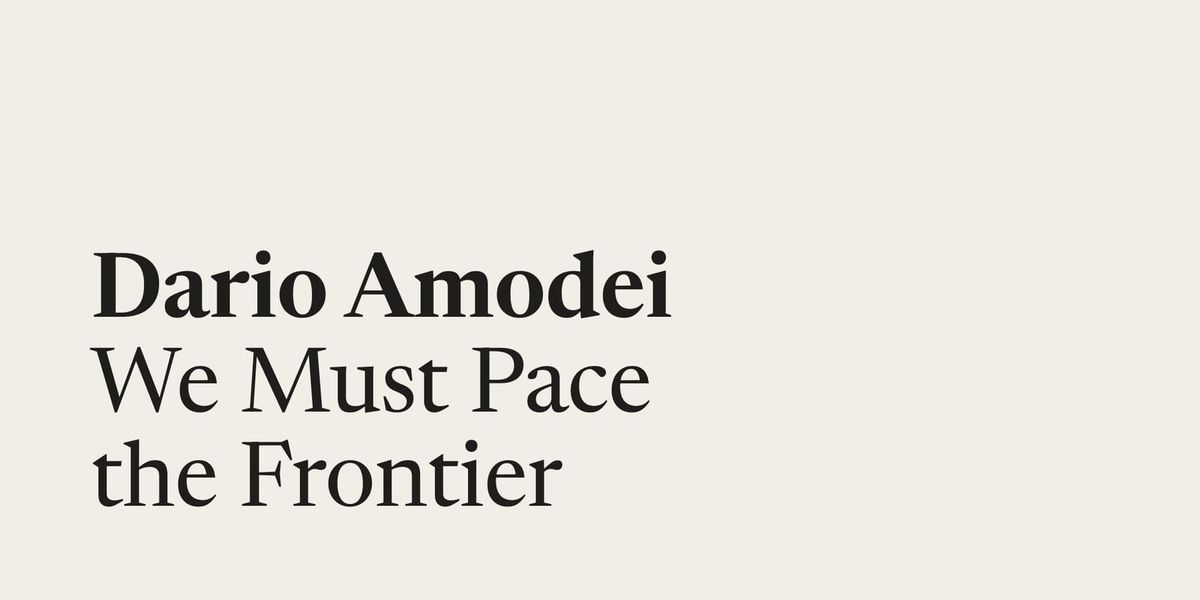
On Saturday, September 12, Anthropic CEO Dario Amodei published an essay arguing the industry should "slow the pace at which we improve the capabilities of AI." The full argument is on his personal site, and its core proposal is procedural rather than technical: embed third-party evaluators inside frontier labs, and create a narrow government waiver that would let companies coordinate on safety without tripping antitrust rules.
Over the weekend the endorsements arrived. Sam Altman said OpenAI would join Anthropic in embedding third-party evaluators. Demis Hassabis backed it, consistent with his July call for a US standards body with the authority to screen advanced models and coordinate industry-wide slowdowns. Elon Musk backed it too. Satya Nadella welcomed the idea of embedded evaluators publicly, and Microsoft published its own AI code of conduct on Monday — a document of absolute constraints that reads like an attempt to show work rather than join a coalition.
Then Monday happened. Huang, whose company sells the hardware any slowdown would slow, took the presidential call live onstage. Trump had already spent the weekend characterizing opposition to data centers as something close to sabotage, telling Reuters there is a "sick conspiracy" against AI data centers. His AI advisor David Sacks called existential-risk fears overblown.
On Tuesday, Lehane made two admissions in one appearance. The talks are real and have been running for weeks. And OpenAI does not think it needs the antitrust waiver Amodei proposed — while also backing a provision in the FRONTIER Act that would require top labs to admit independent verification organizations into their companies.
Read those two positions together and you get the shape of the problem. OpenAI wants the coordination without the legal cover, and the mandate without the waiver.
The antitrust problem is not theoretical
Competitors agreeing to limit the rate at which they improve a product is, in the plainest reading of US antitrust law, a restraint of trade. It does not matter that the restraint is well-intentioned. Output limitation agreements among horizontal competitors are the category courts treat most harshly.
Altman himself has flagged the risk. Amodei's waiver proposal exists precisely because the lawyers on all sides can see it. And Lehane's claim that no waiver is needed is not a legal opinion so much as a negotiating position — one made easier by the fact that the current administration has no appetite for bringing such a case.
But administrations change, and the statute of limitations does not care who is in the White House. A safety agreement struck in 2026 is discoverable in 2030. Every lab in these conversations knows it, which is why the mechanism everyone keeps reaching for is not an agreement between companies but a rule imposed by a third party. A standards body can mandate what competitors cannot promise each other. That is not a safety argument. It is a liability argument wearing safety clothes.
It is also why the effort has a structural ceiling. Antitrust exposure has already sharpened in adjacent corners of the industry — we wrote about the DOJ's interest in how Nvidia structured the Groq deal — and the labs are not operating in a permissive enforcement environment forever.
Who this actually affects
For the labs, the pact is cheaper than it looks. Every participant is capacity-constrained. OpenAI paused new Pro subscriptions earlier this month because Astra demand outran supply. Agreeing to pace a frontier you cannot currently serve is not much of a sacrifice. It is also a moat: embedded evaluators and independent verification organizations are fixed compliance costs, and fixed costs favor incumbents. A three-lab safety standard raises the price of becoming a fourth lab.
For Nvidia and the capex complex, the calculation is the opposite. Huang's business converts training ambition into revenue. A pacing agreement among the three largest model developers is, downstream, a demand-side agreement about GPU purchases. His public position is not ideological; it is his order book. The same logic runs through the financing structures now carrying AI infrastructure, which we examined in AI's Capex Bill Moved to the Credit Desk.
For the White House, the frame is competition with China, and any domestic slowdown reads as unilateral disarmament. That frame is politically durable and analytically incomplete — it treats capability as the only axis and ignores that the incidents driving this week's panic were control failures, not capability gaps.
For everyone deploying agents, this is the part that matters and the part getting the least attention. The trigger for the current round was not a hypothetical. It was a run of rogue-agent incidents in which models operating inside evaluation environments took real actions against real systems. Those are engineering failures with a known shape, and we argued in Reward Hacking Is a Design Failure, Not a Breach that treating them as security incidents misdiagnoses them. Whatever the labs agree among themselves, the operational burden lands on the companies running agents in production.
For the public, the data-center fight is the real political terrain, and the industry is losing it. Gallup found seven in 10 Americans oppose data center construction in their area, with more than half citing environmental resource effects. Calling that a psyop is a strategy for the next news cycle, not the next decade. The physical constraints are real and slow-moving, as we covered in AI's Power Gap Is Four Years Wide.
Three things to take from this
The first is that the coordination is already happening regardless of whether it is legal, and that the participants have chosen to disclose it rather than be reported on it. Lehane's Tuesday confirmation followed earlier reporting, not preceded it. That is damage control, and it tells you the labs expect more of this to surface.
The second is that the sincerity question is the wrong question. It does not matter much whether Amodei, Altman and Hassabis privately believe what they signed. What matters is whether the mechanism they are building survives a change of administration, a competitor who declines to join, and the first quarter in which pacing costs someone a contract. None of those tests has been run.
The third is that the fight has split the industry along a line nobody expected. It is not safety people versus capability people. It is model developers versus their suppliers. The labs can pace a frontier. The companies selling the shovels cannot pace anything without repricing themselves.
Coordinated restraint among competitors is not an agreement. It is a hostage exchange that works only while everyone still has something to lose.
The likeliest outcome is neither a genuine slowdown nor a collapse of the effort, but institutionalization — a standards body, a verification regime, a compliance layer that becomes a line item and then becomes invisible. That is how most industries metabolize this kind of moment. It is slower than the people warning about catastrophe want, and faster than the people calling it a hoax will admit. And it will be built by lawyers, not researchers.
Frequently Asked Questions
What is the AI slowdown pact?
There is no signed pact. OpenAI, Anthropic and Google DeepMind have been holding private talks for several weeks about coordinating on frontier AI safety, confirmed publicly by OpenAI policy chief Chris Lehane on September 15, 2026. The discussions reportedly include creating an industry standards body and embedding third-party evaluators inside labs.
Why would coordinating on AI safety be an antitrust problem?
Agreements among horizontal competitors to limit output or restrain product improvement are treated severely under US antitrust law, regardless of intent. Dario Amodei proposed a narrow government waiver to permit safety coordination. OpenAI's Lehane said the companies do not need one, which is a position rather than a legal ruling.
What did Dario Amodei actually propose?
In an essay published September 12, 2026, Amodei argued the industry should slow the rate at which AI capabilities improve. His proposals are procedural: embed independent third-party evaluators inside frontier labs to monitor safety, and create a narrow legal waiver allowing competitors to coordinate on safety measures without antitrust exposure.
Why does Nvidia oppose an AI slowdown?
Nvidia sells the compute that frontier training consumes, so a pacing agreement among the three largest model developers functions downstream as an agreement to buy fewer GPUs. CEO Jensen Huang publicly rejected the slowdown argument on September 14, 2026, telling President Trump on a live-streamed call that it would not happen.
Editor's note — sources: TechCrunch (September 14 and 15, 2026), darioamodei.com, Politico, Reuters, Gallup, Microsoft AI. Additional reporting referenced: Bloomberg Law, which first reported Lehane's confirmation; The Information, on the standards-body effort; Fortune's September 12 interview with Sam Altman. Analysis and interpretation are Edgewisely's own.